27 July 2026 · By Ruben Jongkind and Michel Hordijk
Italia, dove stai?
A ONEFORTHEGAME perspective on the absence of a four-time world champion
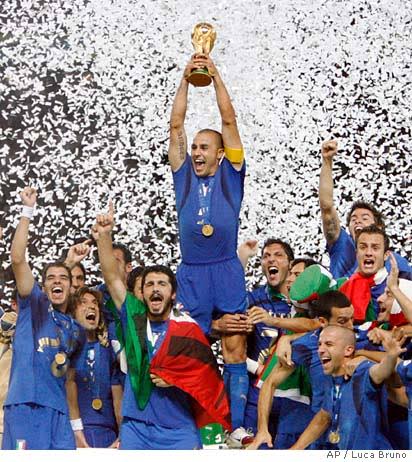
Three World Cups in a row without Italy. Let that sink in for a moment.
In 2017 a playoff against Sweden, without scoring over two legs. In 2022 North Macedonia, one Trajkovski strike in the 92nd minute in Palermo. And this March, in Zenica, Bosnia and Herzegovina on penalties in the first 48-team World Cup, when qualifying was easier than ever. Italy is the first former world champion to miss three consecutive tournaments. Before 2018, they had missed exactly one in their history: 1958.
The ranking tells the same story from a different angle. In 2007, months after lifting the trophy in Berlin, Italy sat first in the world. Today they are 15th, behind Belgium, behind Croatia and even neighbour Switzerland, dropping further after a World Cup they watched on television. Scapegoats found, storylines written. The race for a new head coach has started. However, the head coach completes the work of many, many people over the decade before a tournament. So the question that needs to be asked next to “who should be the next coach?” is “what do we have to do now to have success in a decade?”
Paradox
The talent is demonstrably there: European U19 champions in 2023, U20 World Cup finalists the same year. Yet the federation's own crisis report found the Spaniards from that U19 tournament have since played roughly double the top-flight minutes of their Italian peers and six times more in Europe. The Italians largely stayed in youth teams. The same report placed Serie A 49th of 50 leagues worldwide for minutes given to eligible under-21s: 1.9 percent. So the question is not only how Italy can produce more talent. It is also what happens to it between nineteen and twenty-three?
The oldest league in Europe
Part of the answer may lie in the league itself. Serie A has long been the league of experience: squads consistently average around 26 to 27 years old, with some starting elevens over 30, and foreign players now take roughly two-thirds of all minutes against about 40 percent in Spain. For a young Italian, the path into regular top-flight minutes at home is one of the hardest in Europe.
And here is the double bind: unlike young Brazilians, young Italians hardly leave. Culturally and structurally, Italian talent stays home, waiting for space that rarely comes. Only very recently have players such as Leoni and Coppola moved abroad early and, tellingly, national team coaches from Prandelli to Conte have been sounding the alarm about the shrinking pool for over a decade. When your league doesn't play its own kids and your kids don't go where they would play, where exactly is a generation supposed to develop?
The missing bridge
It took missing the 2018 World Cup for Italy to allow second teams at all: Juventus in 2018, Atalanta in 2023, Milan in 2024, Inter in 2025 — and Milan Futuro promptly relegated out of Serie C. Four B teams in a country of Italy's size, decades after Spain and Germany made the reserve-team bridge a cornerstone. For most Italian academies, the step from Primavera to senior football simply doesn't exist inside the club.
And what does that Primavera contain? Studies of Serie A academies — the Inters, Milans, Juves, Romas and Atalantas of this world — show a relative age effect among the most extreme in Europe: in 2017–18, only 5% of U15, 6% of U16, 11% of U17 and 10% of Primavera players were born in the last quarter of the year. A quarter of the birth calendar, reduced to a twentieth of the squad list. Twenty-five years of youth national team selections, U15 to U21, show the same skew, and the relatively younger players who survive the filter have the highest likelihood of making it at senior level. Is the system throwing away precisely the players most likely to become its best?
The paper and the pitch
This does not puzzle us. The current package was introduced in 2025 and, on paper, it looks promising — almost Cruyffian. But its results will take five to ten years to become visible. And because countries such as the Netherlands, England, Switzerland, Belgium and Norway have been working in a similar direction for longer — with Greece now following this path on our advice — Italy will need to go several steps further. The official FIGC framework:
| Category | Age | Official format (FIGC, 2024/25) |
|---|---|---|
| Piccoli Amici | U6–U7 | 2v2–3v3, alternated with technical skill games |
| Primi Calci | U8–U9 | 4v4–5v5, plus 2v2/3v3 pre-match situations |
| Pulcini | U10–U11 | 7v7 (or 5v5), self-refereed by the players |
| Esordienti | U12–U13 | 9v9 (7v7 first year), with small-sided games |
| Giovanissimi | U14–U15 | Full 11v11 — start of competitive activity |
Self-refereeing has been mandatory in the Pulcini since the mid-2010s; trials and scouting gatherings are forbidden before twelve. The federation's own documents state that talent is built over time, not selected at eight. Since January 2025 the package comes with interactive posters and a national roadshow for coaches, officials and parents: “everyone plays, more and better.”
Fabio Capello said days after the Bosnia defeat that the most serious mistake lies in the youth sectors: twelve-year-olds drilled in tactical schemes, because it is easier to draw diagrams than to teach technique, by coaches who too rarely understand growth and maturation. Roberto Baggio wrote a report for the federation saying essentially the same — prioritise ball mastery, dribbling and joy until fifteen — in 2012, before any of these reforms existed. Was that report shelved? If the framework says one thing and the culture does another, which one is actually training the players? We saw the answer up close at Volendam, working with top youth players from the Italian system: real strengths — a will to win and fight, great team players and sound tactical understanding — but consistent gaps: position-specific technique and technical refinement, physical liabilities, and opportunities for improving autonomy and the willingness to try something the coach hadn't scripted. These players had been coached primarily as parts of a team and not both as part of a team and as individuals with their particular strengths and weaknesses.
Reform or repair?
To be fair: Italy is not standing still. Besides the grassroots package, 2025 brought the Zola Reform, turning Serie C into a declared development league, youth-minutes bonuses raised up to 400%, a rising home-grown quota in every squad list, salary-cap fines redirected to clubs that play their kids; home-grown players are already up 48%, their minutes up 25%. And after the Bosnia defeat, a government-backed plan reserved half of a new funding stream for academies and facilities, plus tax relief for clubs contracting 18-to-23-year-olds raised in Italian academies.
These are good measures, but they remain repair work. Italy must do more than match what Norway, Belgium and Switzerland have already done; it must innovate beyond them. Every part of a holistic national football strategy — from a national identity, match and competition formats, coaching curriculum, talent identification and organisation to regulation — must be addressed together and in genuinely new ways. The aim cannot be merely to close the gap, but to overtake the countries now ahead and return Italy to the absolute top of world football. A very good national team coach would undoubtedly help, because the talent is there. But is that enough? And is it not dangerously risky to make the future of Italian football depend on one person?
Italy could benefit from a national development plan built on Italy's own identity: protect the defensive intelligence that is genuinely Italian, and rebuild the environment that produced fantasisti: individual technique and 1v1 mastery first, freedom to make mistakes, maturation-aware scouting that stops discarding late-born players, real bridges from academy to senior football across the whole pyramid, and the courage to let young Italians play, at home or abroad. And then the hardest part: a player shaped by today's reforms reaches the Azzurri around 2035. Does Italian football have the patience to protect this work through two more cycles of pressure from fans, media and coaches — or will the next bad result sweep it away too?
Norway did it with a fraction of Italy's resources and history. Italy does not lack the football culture. The question is whether it can find the patience to trust it.
“Sometimes something has to happen before something happens.”
— Johan Cruyff
If you carry responsibility for a federation or club asking these same questions — about pathways, playing time and the patience a rebuild demands — this is the work we do every day with federations and clubs. A confidential conversation starts through our contact page.
ONEFORTHEGAME
← Back to Blogs